
Finished, utility and laundry basements
Basement Floor Epoxy in Des Plaines, IL
A sealed, washable basement floor, installed after we measure the moisture coming up through the slab.
- Free estimate with a slab moisture reading
- Itemized written price before any grinding starts
- Cracks and pitted concrete repaired before coating
Basement Floors in a Town Named for a River
Basement floor epoxy gives a concrete basement a sealed, bright surface that is easy to mop and does not hold odors the way carpet can. In Des Plaines, it is also a practical choice. The city sits on the Des Plaines River, many homes stand on clay-rich soil, and summer storms can overload sewers. Basement floors here get wet more often than homeowners would like. A resin floor will not keep water out, but it is far easier to clean and dry than carpet, tile grout or bare concrete.
Know the water history first
A February 2022 letter from the city's Public Works and Engineering Department lists the Des Plaines River, Weller Creek, Farmers Creek, Prairie Creek, Higgins Creek, Willow Creek and Feehanville Ditch as local flood sources. It calls April 2013 the worst flood in city history, when the river reached 20.92 feet, and it names fifteen repetitive loss areas. The same letter warns that overloaded sewers can back up into basements and encourages residents to consider overhead sewers or flood control systems. If your basement has flooded or backed up before, tell us. We will plan around it, and in some cases we will suggest dealing with the water before coating.
Moisture coming up through the slab
Flooding is only one source of water. Vapor also rises through the concrete from the soil below. The USDA describes the Morley soil series, found across eastern Illinois, as clay loam and silty clay loam glacial till with very slow permeability in the substratum. Slow-draining clay can keep the ground under a basement damp long after rain stops. When that vapor pushes against a coating that is not built for it, the coating blisters and peels. That is why we read moisture on every basement before recommending a system.
Humidity and condensation
The EPA recommends keeping indoor relative humidity below 60 percent, ideally between 30 and 50 percent. It also notes that condensation can form when warm, humid air meets a cold surface. In a Des Plaines summer, a cool basement slab under muggy air can sweat. A dehumidifier helps the coating cure and helps the finished floor stay dry.
Options for different basements
- Utility and laundry areas: a solid color or light flake system with a chemical-resistant topcoat, easy to mop after a washer leak.
- Finished living space: a smooth, low-sheen floor or a flake blend that looks finished without rugs everywhere.
- Workshops and storage: a thicker epoxy build that handles rolling tool carts and dropped tools.
- Damp slabs: a moisture-tolerant primer under the main coat where readings call for it.
Prep on mid-century basements
Many Des Plaines basements date from the 1950s and 1960s. We often find old floor paint, carpet glue, tile adhesive, cracks near floor drains and patches from past plumbing work. Adhesives and paint have to be ground off. Cracks get filled, and floor drains stay open and working, with the coating feathered to the drain body. We do not cover sump pits or cleanouts.
Radon and finishing a basement
The American Lung Association, citing the Illinois Emergency Management Agency, reports that about 45 percent of Illinois homes tested were at or above the EPA action level of 4 pCi/L. Sealing a floor with a coating is not a radon mitigation system. If you are finishing a basement, testing first is a good idea, and any mitigation work that cuts into the slab should be done before we coat.
After a flood
If water does get in, a coated floor can usually be squeegeed, washed and disinfected without tearing anything out. That is a big difference from carpet and pad. Let the floor and room dry fully, and call us if you see the coating lifting anywhere afterward.
What This Covers
Basement floor work from bare slab to finished, sealed surface.
Moisture testing
Slab moisture readings taken before we recommend or price a system.
Adhesive and paint removal
Old carpet glue, tile mastic and floor paint ground off to clean concrete.
Crack and drain-area repair
Cracks filled and the coating finished neatly around floor drains.
Moisture-tolerant primer
A primer layer for slabs with elevated vapor readings, when the readings allow coating at all.
Finish coats
Solid color, flake or a smooth low-sheen topcoat for living space.
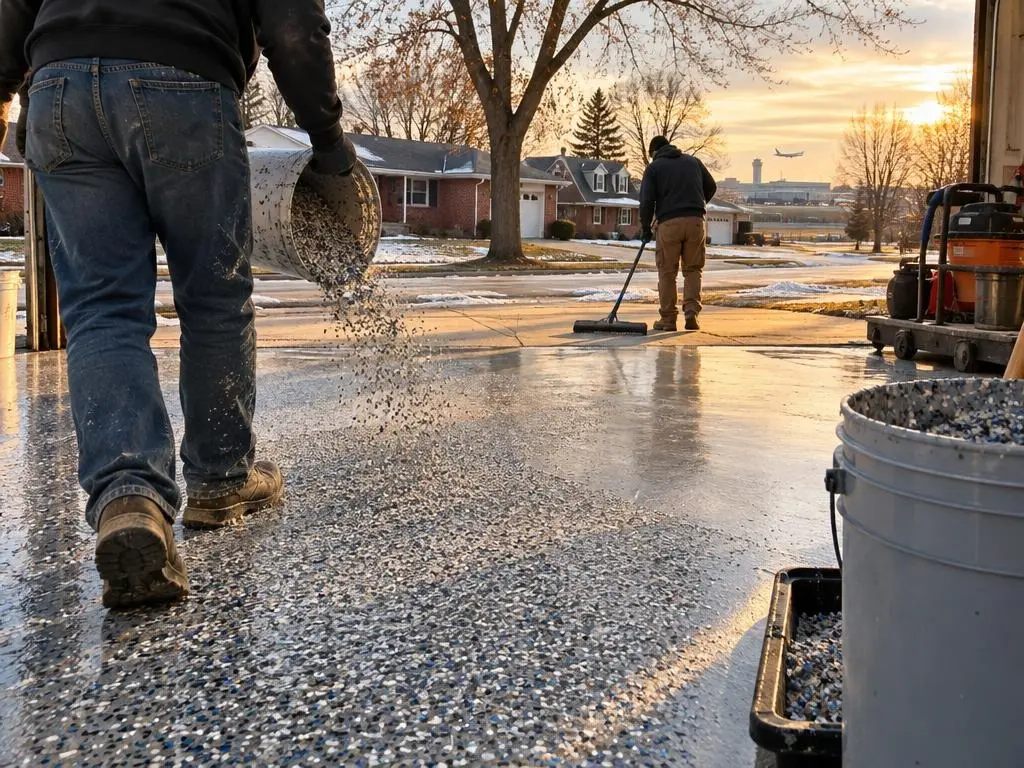
Typical Basement Floor Epoxy Costs
| Job | Published range |
|---|---|
| Installed epoxy, per sq ft | $4 to $10 |
| Basement floor, 300 to 2,000 sq ft | $1,200 to $20,000 |
| Moisture barrier, when needed | about $1 per sq ft |
| Crack or chip patching | $25 to $250 |
| Foundation repair, if cracks are structural | $2,150 to $7,730 or more |
National ranges from HomeGuide (epoxy and basements), Bob Vila (moisture barrier) and HomeAdvisor (patching and foundation repair). Moisture readings and old adhesives change basement prices more than anything else. Your written estimate is the price.
How It Works
1. Walk-through and moisture test
We ask about past flooding, read slab moisture and note cracks, drains and old finishes.
2. Clear and grind
Adhesives and paint come off, and the slab is diamond ground and vacuumed.
3. Repair and prime
Cracks are filled and a moisture-tolerant primer goes down where needed.
4. Coat and dry out
Finish coats are applied with dehumidification on, and you get written cure times.
Basement Floor Epoxy Questions
Is epoxy a good idea for a basement that has flooded before?
It can be, because a sealed floor cleans up much faster than carpet. It will not stop water from coming in, so we suggest fixing the cause first. The city's 2022 letter points residents to overhead sewers and flood control devices for sewer backups.
Why do basement floor coatings peel?
Usually moisture vapor pushing up through the slab, or a coating applied over paint, glue or unground concrete. We test moisture and grind to clean concrete for that reason.
How much does it cost to epoxy a basement floor?
HomeGuide lists about $1,200 to $20,000 for basements of 300 to 2,000 square feet, which is $4 to $10 per square foot. A moisture barrier, when needed, adds about $1 per square foot according to Bob Vila.
Does a basement floor coating help with radon?
No. A coating is not a radon mitigation system. About 45 percent of Illinois homes tested are at or above the EPA action level, so test first and finish any mitigation work before coating.
Basement Floor Epoxy Service Areas
- Epoxy Flooring in Des Plaines, IL
- Epoxy Flooring in Park Ridge, IL
- Epoxy Flooring in Mount Prospect, IL
- Epoxy Flooring in Arlington Heights, IL
- Epoxy Flooring in Niles, IL
- Epoxy Flooring in Morton Grove, IL
- Epoxy Flooring in Glenview, IL
- Epoxy Flooring in Northbrook, IL
- Epoxy Flooring in Prospect Heights, IL
- Epoxy Flooring in Wheeling, IL
- Epoxy Flooring in Elk Grove Village, IL
- Epoxy Flooring in Rolling Meadows, IL
- Epoxy Flooring in Palatine, IL
- Epoxy Flooring in Schaumburg, IL
- Epoxy Flooring in Buffalo Grove, IL
- Epoxy Flooring in Deerfield, IL
- Epoxy Flooring in Vernon Hills, IL
- Epoxy Flooring in Franklin Park, IL
- Epoxy Flooring in Bensenville, IL
- Epoxy Flooring in Wood Dale, IL
- Epoxy Flooring in Itasca, IL
Get a Basement Floor Epoxy Estimate
Free basement floor estimates with a moisture reading in Des Plaines.