
Northwest Cook County concrete coatings
Epoxy Flooring in Des Plaines, IL
Coatings for 1950s and 1960s slabs, salty winter garages and basements near the river, installed after grinding and a moisture check.
- Free estimate with a slab moisture reading
- Itemized written price before any grinding starts
- Cracks and pitted concrete repaired before coating
Concrete Coatings Planned Around Des Plaines Floors
Epoxy flooring in Des Plaines starts with the age of the concrete. Census figures from the 2019 to 2023 American Community Survey, as summarized by Point2Homes, put the city's median year built at 1966, and about 43% of its homes went up in the 1950s and 1960s alone. Many of those garages and basements still have the original slab. A good coating can make that floor easy to clean and hard-wearing again, but only when the old concrete is ground, repaired and checked for moisture first.
Why the postwar slab matters
Des Plaines grew quickly after World War II, helped by the opening of O'Hare next door. Wikipedia records the population jumping from 14,994 in 1950 to 34,886 in 1960. Garages from that era are often narrower, and their floors have had sixty-plus winters of use. We regularly find cracks that run from the door to the back wall, chipped control joints, low spots that hold water and layers of gray floor paint. Paint has to come off. Cracks have to be filled. The slab has to be opened by a diamond grinder so the resin can grab it. Skip those steps and even an expensive coating will lift.
Winters at the garage door
The weather station at O'Hare, about 2.5 miles from downtown Des Plaines, averages 38.4 inches of snow a year, and January's daily mean is 25.2°F. Snow means road salt, and salt rides home on your tires. Brine dripping onto bare concrete soaks in, and repeated freezing near the door slowly flakes the surface. A sealed resin floor keeps that brine on top, where a squeegee can push it out. We add texture with flake or an anti-slip additive so the floor is not slick when it is wet.
Basements in a river town
The city takes its name from the Des Plaines River, which runs just east of downtown. A February 2022 letter from the city's Public Works and Engineering Department calls April 2013 the worst flood in Des Plaines history, with the river reaching 20.92 feet. The same letter notes fifteen designated repetitive loss areas and warns that overloaded sewers can back up into basements during heavy storms. A coated basement floor cleans up far more easily after water than carpet or bare concrete. A coating will not keep water out, though. If your basement takes on water, the water problem gets solved first, and we will tell you if we see signs of it.
Moisture, clay and radon below the slab
Much of northeastern Illinois sits on clay-rich glacial till. The USDA describes the Morley soil series, mapped across eastern Illinois, as 35 to 50 percent clay with very slow permeability in the substratum. Soils like that can hold water against a basement floor for days after a storm. Vapor moving up through the concrete is the main reason basement coatings blister, so we read slab moisture before recommending a system and use a moisture-tolerant primer where readings call for it. Radon is a separate concern. The American Lung Association, citing the Illinois Emergency Management Agency, reports that about 45 percent of Illinois homes tested were at or above the EPA action level of 4 pCi/L. A coating is not radon mitigation, so we suggest testing before you finish a basement.
Systems we install
- Garage floor epoxy: a ground, repaired slab with an epoxy base and a clear protective topcoat.
- Polyaspartic coatings: fast-curing and UV-stable, useful when you need the garage back the next day.
- Flake floors: colored chips broadcast into the base coat for texture and to hide winter grime.
- Basement floor epoxy: moisture-checked systems for finished and utility basements.
- Crack and floor repair: filling, patching and leveling old concrete, with or without a coating.
- Commercial and warehouse floors: thicker, high-solids systems for shops and light industrial space near O'Hare.
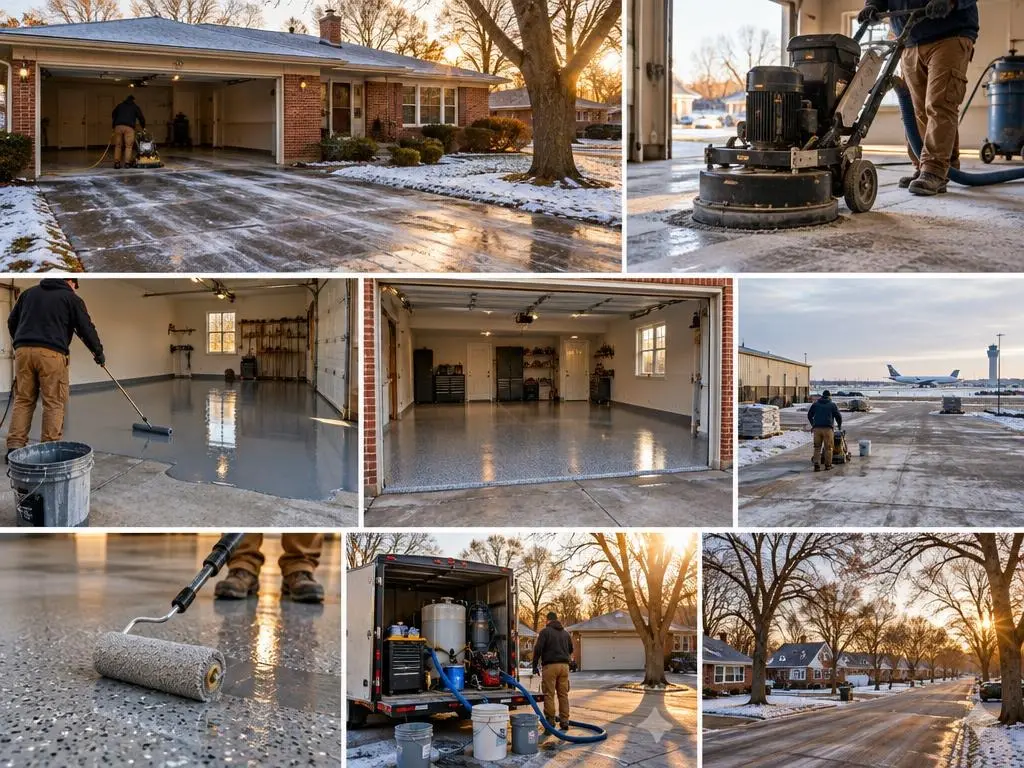
What happens on install day
- Belongings out and the space protected
- Diamond grinding wall to wall, then a full vacuum
- Cracks, spalls and joints filled and ground flush
- Primer or base coat, broadcast or color coat, and topcoat
- Written cure times for walking, moving items back and parking
Why Homeowners Call Des Plaines Epoxy Flooring Pros
Old slabs get real prep
Every floor is diamond ground and every crack, spall and joint is repaired before coating. Mid-century concrete needs it.
Moisture read on every basement
Clay soils and a history of flooding make basement moisture common here, so we test before we choose a system.
Built for salt season
Garage systems get a chemical-resistant topcoat and added texture so winter brine stays on the surface and the floor stays walkable.
A price you can read
Your quote shows square footage, each prep step, each coat and the total. Changes are written and approved before work.
Common Questions
Does epoxy flooring cost a lot?
It costs more than paint and less than most new floor coverings. HomeGuide lists professional epoxy at about $4 to $10 per square foot installed, or about $1,600 to $5,800 for a two-car garage. Older slabs with paint, cracks or salt damage need more prep, which raises the price. We give you a written figure after we see the floor.
How much does it cost to epoxy a 100 square foot floor?
At HomeGuide's $4 to $10 per square foot, 100 square feet works out to about $400 to $1,000. Small jobs often land near the top of that range because grinding equipment and setup cost the same whether the floor is small or large. A laundry room or entry is often easier to justify when it is done with a garage or basement.
Can I use a kit from a home improvement store instead?
You can. HomeGuide puts premade kits at about $200 to $700 and says water-based epoxy lasts about 3 to 5 years, against 10 to 20 years for solid epoxy. Most kits rely on etching instead of grinding, which is a problem on an older Des Plaines slab with paint or salt damage. Kits work best on newer, clean concrete.
Will an epoxy floor stop my basement from flooding?
No. A coating seals the surface and makes cleanup much easier, but it cannot stop river water, groundwater or a sewer backup. The City of Des Plaines has encouraged residents to look at overhead sewers or flood control devices for backup problems. Fix the water first, then coat the floor.
How long before I can park on a new garage floor?
It depends on the product and the temperature. Bob Vila's polyaspartic guide gives about 24 hours before vehicles for polyaspartic and about three full days for standard epoxy. We give you a specific time for your floor.
Can you coat a floor that already has paint or an old coating on it?
Yes, after it is removed. A new coating is only as strong as the layer under it, and old paint that is peeling at the tire paths will take the new floor with it. Grinding off the old finish is part of the quote when we see it.
Do you install floors in winter?
Yes, when the slab and air temperature fit the product. HomeGuide lists 60°F to 85°F as the range for epoxy, while polyaspartic has a much wider application range. In cold months we check the slab temperature and may heat the space or choose a polyaspartic system.
Where We Work
Our base is Des Plaines, and we coat floors across northwest Cook County and the edges of Lake and DuPage counties. That includes Park Ridge, Mount Prospect, Arlington Heights, Niles, Morton Grove, Glenview, Northbrook, Prospect Heights, Wheeling, Elk Grove Village, Rolling Meadows, Palatine, Schaumburg, Buffalo Grove, Deerfield, Vernon Hills, Franklin Park, Bensenville, Wood Dale and Itasca. Inner suburbs like Park Ridge and Niles have more older brick homes and detached garages. Villages built from the late 1950s on, such as Elk Grove Village, Buffalo Grove and Vernon Hills, have more attached garages with slabs in better shape. The industrial parks around O'Hare add shops and warehouses to the mix. Each town page explains what we tend to find there.
- Epoxy Flooring in Des Plaines, IL
- Epoxy Flooring in Park Ridge, IL
- Epoxy Flooring in Mount Prospect, IL
- Epoxy Flooring in Arlington Heights, IL
- Epoxy Flooring in Niles, IL
- Epoxy Flooring in Morton Grove, IL
- Epoxy Flooring in Glenview, IL
- Epoxy Flooring in Northbrook, IL
- Epoxy Flooring in Prospect Heights, IL
- Epoxy Flooring in Wheeling, IL
- Epoxy Flooring in Elk Grove Village, IL
- Epoxy Flooring in Rolling Meadows, IL
- Epoxy Flooring in Palatine, IL
- Epoxy Flooring in Schaumburg, IL
- Epoxy Flooring in Buffalo Grove, IL
- Epoxy Flooring in Deerfield, IL
- Epoxy Flooring in Vernon Hills, IL
- Epoxy Flooring in Franklin Park, IL
- Epoxy Flooring in Bensenville, IL
- Epoxy Flooring in Wood Dale, IL
- Epoxy Flooring in Itasca, IL
Floor Coating Services
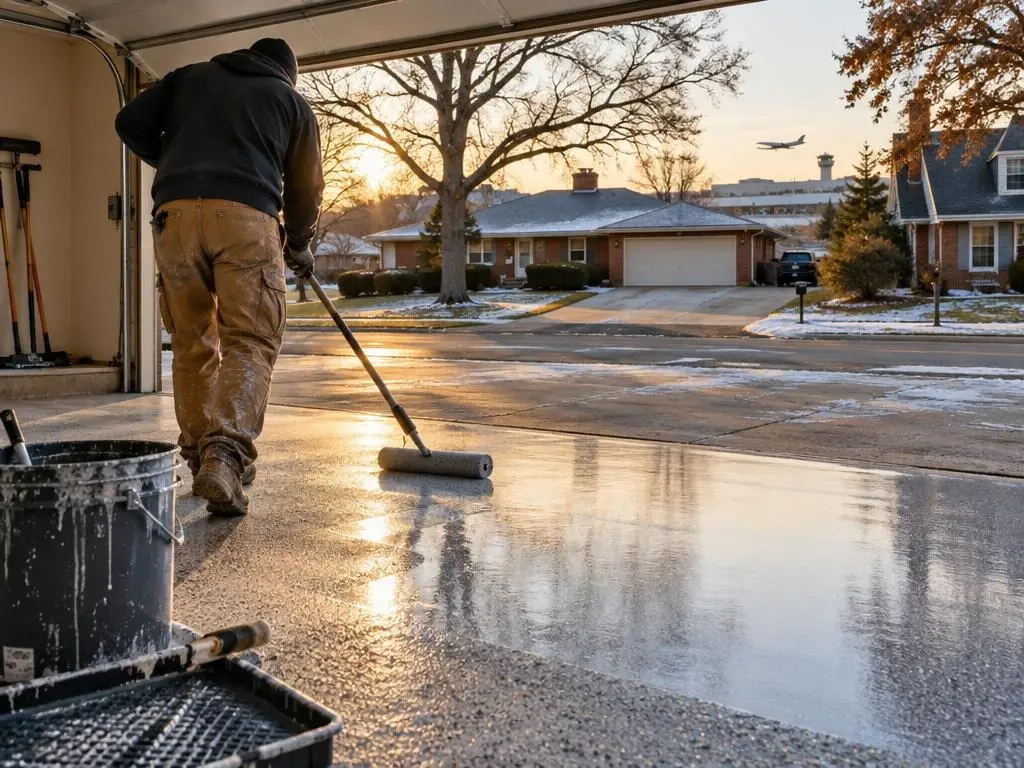
Six services built around the floors we find in Des Plaines: older garage slabs, basements near the river and busy work floors around O'Hare.
Garage Floor Epoxy
Ground, repaired and sealed garage slabs that keep winter brine on the surface and look clean year round.
Learn more →Polyaspartic Floor Coating
Fast-curing, UV-stable coatings that can return your garage to use in about a day.
Learn more →Epoxy Flake Floors
Colored chips broadcast into the coating for grip, texture and a floor that hides salt spots.
Learn more →Basement Floor Epoxy
Moisture-tested coatings for basements, built for easy cleanup in a river town with clay soils.
Learn more →Concrete Crack & Floor Repair
Filling cracks, pits and broken joints in older slabs, as a standalone job or before a coating.
Learn more →Commercial & Warehouse Floor Epoxy
High-build resin floors for shops, warehouses and work areas around O'Hare's industrial corridor.
Learn more →Get an Epoxy Flooring Estimate
Free on-site estimates in Des Plaines and nearby northwest suburbs.