
Where Salt Creek begins
Epoxy Flooring in Palatine, IL
Moisture-checked coatings for Palatine garages and basements, many built during the village's big growth years.
- Free estimate with a slab moisture reading
- Itemized written price before any grinding starts
- Cracks and pitted concrete repaired before coating
Palatine Floors From the 1970s to the 1990s
Epoxy flooring in Palatine fits a particular kind of house. The village had 26,050 people in 1970 and 65,479 by 2000, according to census counts on Wikipedia. Many homes from those decades have attached garages, and many have basements. Their slabs are now 25 to 55 years old, which is right about when people start thinking about a coating.
Wet ground under the village
Wikipedia describes Palatine as sitting in wooded marshland where several streams rise. Most of them join Salt Creek, which starts at Wilke Marsh on the east side of the village. Ground like that holds water. It does not make every basement damp, but it is a good reason to test before coating.
Here is why. Concrete is porous. When the soil around a slab stays wet, moisture moves up through it as vapor. A coating on top can trap that vapor, and pressure builds until the coating blisters or lets go. We check moisture with a meter at several spots in every basement and garage we price. When readings are high, we use a primer made for damp concrete or tell you the floor is not a good candidate yet.
Basement floors
Palatine basements are often used as play rooms, home gyms, laundry and storage. A coated floor is easier to clean and reflects more light than gray concrete. We recommend:
- A moisture test before any quote
- A light, solid color or light flake for a brighter room
- Leaving floor drains and sump pits fully accessible
- Fixing any active leaks first, since a coating does not stop water
Garages built during the boom
Garages from Palatine's growth years are usually attached and wider than 1950s garages, so a two-car floor runs larger. These slabs often have fewer deep cracks than older ones, but they show other problems: a smooth, dense trowel finish that coatings do not stick to without grinding, salt scaling at the door, and oil stains where cars have parked for decades.
Winter is a real factor. The village's climate data shows an average January high of 28.7°F and about 38.5 inches of snow a year. That means months of melting slush on the floor. A sealed floor with flake texture handles it well and stays safer to walk on when wet.
Which system we usually suggest
- Polyaspartic over an epoxy base: a fast cure and a clear topcoat that does not yellow.
- Full flake broadcast: hides salt film between cleanings.
- Crack and joint repair: included where needed and listed on the quote.
A village with a long history
Palatine was founded in 1866 around a station on the Chicago and North Western Railway. Homes near the old village center can be much older than the subdivisions around them. If you live in one of those, the concrete may have been replaced or patched over the years. We look at each floor on its own terms.
What install day looks like
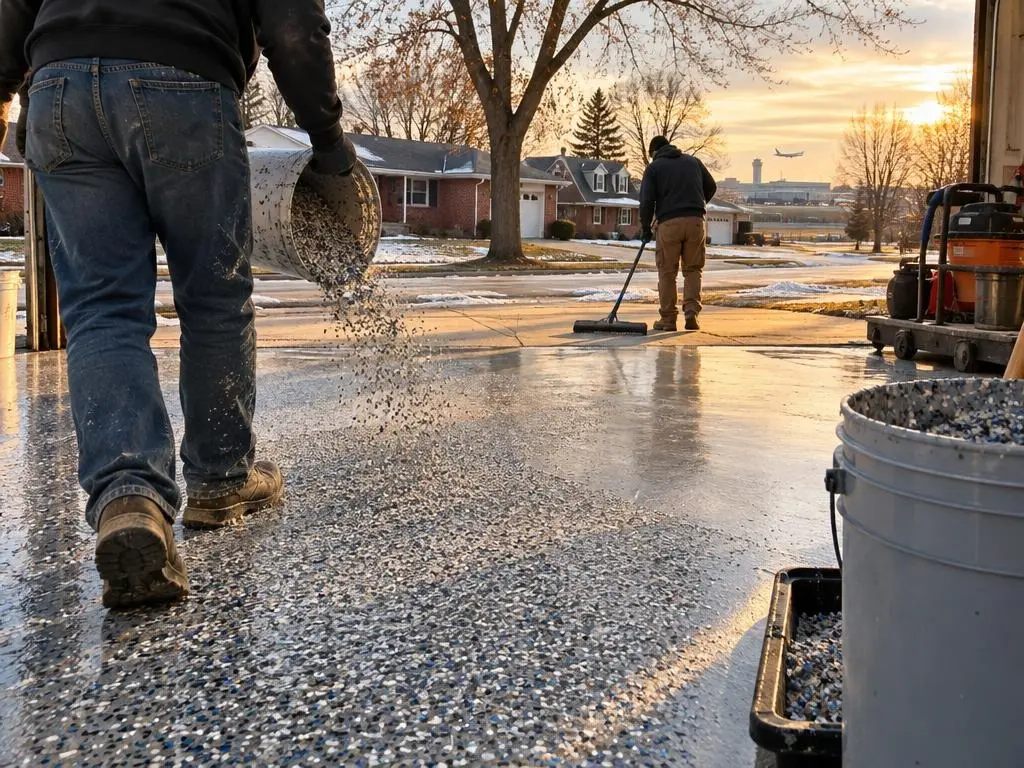
We clear and protect the space, then diamond grind the full floor and vacuum the dust. Cracks and joints are filled and ground flush. The primer or base coat goes down next, followed by flake if you chose it, and then the topcoat. Before we leave, you get written times for walking on the floor, moving things back and parking.
Palatine Facts That Shape a Floor Job
- Rapid growth from 1970 to 2000. Census counts show Palatine growing from 26,050 people in 1970 to 65,479 in 2000. The village had 29,058 housing units in 2020.
- Marshland and Salt Creek. The village sits in wooded marshland where several streams rise, and Salt Creek starts at Wilke Marsh on the east side.
- Cold, snowy winters. Climate normals show a January average high of 28.7°F and about 38.5 inches of snow a year.
- A railroad village. Palatine was founded in 1866 around a station on the Chicago and North Western Railway, so homes near the center are older.
Palatine Questions
Do Palatine basements need a moisture test before epoxy?
Every basement does, and we test them all. On damp ground it matters more. If readings are high, we use a moisture-tolerant primer or advise waiting until the water source is fixed.
My garage is from the 1980s and has few cracks. Do you still grind it?
Yes. Newer slabs often have a smooth, hard surface that coatings cannot grip. Grinding opens the concrete so the base coat bonds.
Can you coat a garage in winter?
If the garage is heated and the slab is warm enough, often yes. We check slab temperature on the day and reschedule if it is too cold to cure properly.
Free Estimates in Palatine, IL
Free moisture-checked estimates for Palatine garages and basements.
Epoxy Flooring Near Palatine
- Epoxy Flooring in Des Plaines, IL
- Epoxy Flooring in Park Ridge, IL
- Epoxy Flooring in Mount Prospect, IL
- Epoxy Flooring in Arlington Heights, IL
- Epoxy Flooring in Niles, IL
- Epoxy Flooring in Morton Grove, IL
- Epoxy Flooring in Glenview, IL
- Epoxy Flooring in Northbrook, IL
- Epoxy Flooring in Prospect Heights, IL
- Epoxy Flooring in Wheeling, IL
- Epoxy Flooring in Elk Grove Village, IL
- Epoxy Flooring in Rolling Meadows, IL
- Epoxy Flooring in Schaumburg, IL
- Epoxy Flooring in Buffalo Grove, IL
- Epoxy Flooring in Deerfield, IL
- Epoxy Flooring in Vernon Hills, IL
- Epoxy Flooring in Franklin Park, IL
- Epoxy Flooring in Bensenville, IL
- Epoxy Flooring in Wood Dale, IL
- Epoxy Flooring in Itasca, IL