
The old brick town across the river
Epoxy Flooring in Park Ridge, IL
Garage and basement coatings for some of the oldest concrete in the northwest suburbs, prepared by hand where it needs it.
- Free estimate with a slab moisture reading
- Itemized written price before any grinding starts
- Cracks and pitted concrete repaired before coating
Coating the Oldest Floors on Our Route
Park Ridge has some of the oldest concrete we coat, and that shapes every epoxy flooring job we do in Park Ridge. Per American Community Survey data summarized by Point2Homes, the city's median home was built in 1960. About 16.2% of homes date to 1939 or earlier, and another 27.5% went up in the 1950s. Those are the highest older-home shares among the towns we serve, and the floors show it.
A town built on clay
Park Ridge was first called Pennyville, after George Penny, who started a brickworks here in 1854. Wikipedia notes that the soil is rich in clay deposits, which made the town a brick-making center for a growing Chicago and earned it the name Brickton. It was incorporated in 1873.
The same clay that made good brick drains slowly. Water that soaks into clay ground can sit against foundation walls and under basement floors long after a storm. For a coating, that means vapor can move up through the slab. Moisture pushing up from below is a common reason basement epoxy bubbles or peels, so in Park Ridge a moisture reading is the first thing we do in any basement.
What we find in Park Ridge garages
Older garages here come in many shapes. Some are original to the house and some were rebuilt decades later. Common problems we see:
- Slabs poured thinner or rougher than modern ones, with dips that hold water
- Long settlement cracks and broken edges at the door apron
- Several layers of paint or old sealer, sometimes peeling at the tire paths
- Patches from past repairs that sit higher or lower than the floor around them
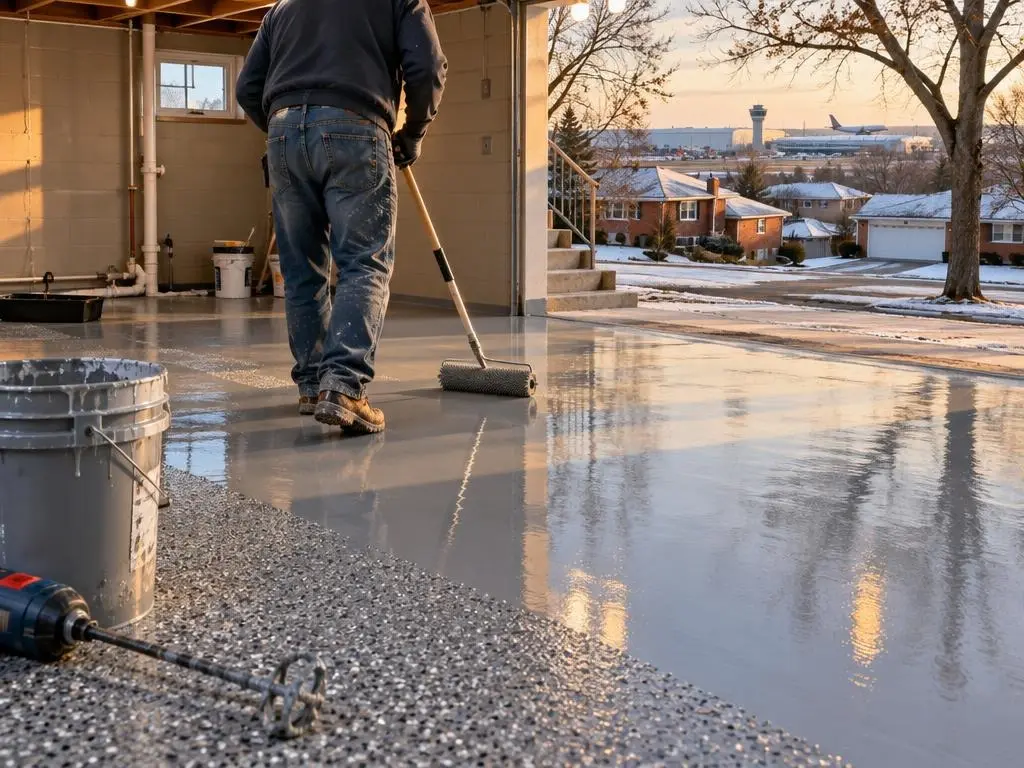
None of these stop a coating. They change how much prep the job needs. We grind away old finishes, fill and grind cracks flush, and use a patching compound or leveling material on the low spots. A floor that started out rough can end up flat, sealed and easy to sweep.
Basements in older homes
With 84.8% of occupied homes owner-occupied, Park Ridge has many families who have lived in the same house for years and are now finishing or updating the basement. A pre-war basement may have a floor that was never meant to be a living space. Before we coat one we check:
- Moisture, with a reading taken on the slab itself
- Old flooring glue, from tile or carpet that has been pulled up
- Cracks at the walls and floor drains, where water usually enters
If a basement has an active leak, we will tell you that a coating is not the fix. When the slab is dry and stable, our basement epoxy gives you a bright, washable floor for a laundry room, gym or storage area.
Detached garages and short winter days
Many older Park Ridge homes have a detached garage at the back of the lot. These are often unheated, which matters for coatings. Standard epoxy needs warmer temperatures to cure well, so in cold months we either schedule around a mild stretch or recommend polyaspartic, which can be applied in a much wider temperature range. We check the slab temperature on the day of install and will reschedule rather than coat a floor that is too cold.
Picking a system for an older Park Ridge floor
- Epoxy flake floors hide the small surface flaws that are left on an old slab even after repair.
- Polyaspartic topcoats are UV-stable, which helps in detached garages where the door is open on sunny days.
- Concrete crack and floor repair can be done on its own if you only want the slab fixed and sealed for now.
We will tell you which combination fits once we have seen the floor. Call (224) 501-9895 to book an estimate.
Park Ridge Facts Behind Our Approach
- Brickton's clay. George Penny started a brickworks here in 1854. The soil is rich in clay deposits, which made Park Ridge a brick-making center for Chicago.
- Older housing. Per ACS data on Point2Homes, the median home was built in 1960, with 16.2% built in 1939 or earlier and 27.5% in the 1950s.
- Growth to 1970. Census counts rose from 16,602 in 1950 to 32,659 in 1960 and 42,614 in 1970. The 2020 count was 39,656.
- Long-term owners. About 84.8% of occupied homes are owner-occupied, and Wikipedia lists 15,366 housing units in 2020.
Park Ridge Questions
Can you coat a garage floor that is almost 100 years old?
In most cases, yes. Old slabs need more prep. We grind off paint and loose material, fill cracks, and level low spots. If a floor is crumbling or badly heaved, we will tell you it needs concrete work before any coating.
Why do you test moisture in every Park Ridge basement?
The clay soil under much of the city holds water. Vapor coming up through a basement slab is a leading cause of coating failure. A reading tells us whether the floor can take a standard epoxy or needs a moisture-tolerant primer first.
Free Estimates in Park Ridge, IL
Free estimates for Park Ridge garages and basements, old and new.
Epoxy Flooring Near Park Ridge
- Epoxy Flooring in Des Plaines, IL
- Epoxy Flooring in Mount Prospect, IL
- Epoxy Flooring in Arlington Heights, IL
- Epoxy Flooring in Niles, IL
- Epoxy Flooring in Morton Grove, IL
- Epoxy Flooring in Glenview, IL
- Epoxy Flooring in Northbrook, IL
- Epoxy Flooring in Prospect Heights, IL
- Epoxy Flooring in Wheeling, IL
- Epoxy Flooring in Elk Grove Village, IL
- Epoxy Flooring in Rolling Meadows, IL
- Epoxy Flooring in Palatine, IL
- Epoxy Flooring in Schaumburg, IL
- Epoxy Flooring in Buffalo Grove, IL
- Epoxy Flooring in Deerfield, IL
- Epoxy Flooring in Vernon Hills, IL
- Epoxy Flooring in Franklin Park, IL
- Epoxy Flooring in Bensenville, IL
- Epoxy Flooring in Wood Dale, IL
- Epoxy Flooring in Itasca, IL